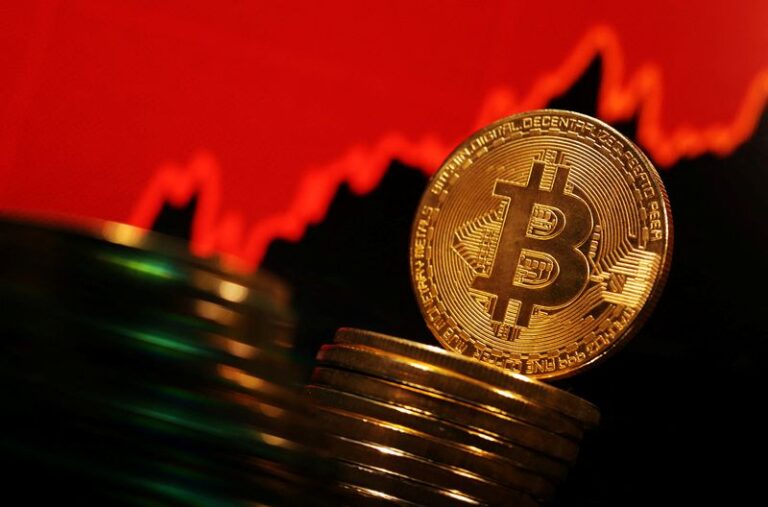
Bitcoins on ladder chart cryptocurrency background concept.
Bitcoin’s Recent Surge
The recent surge in Bitcoin, which saw its price soar above $126,000, can be attributed to a confluence of market trends, investor sentiment, and notable events within the cryptocurrency ecosystem. Central to this rise was an amplified interest from institutional investors, spurred by a growing acceptance of digital currencies as viable investment vehicles. Various large entities began to allocate significant portions of their portfolios to Bitcoin, thus contributing to the increased demand and driving prices higher.
Moreover, regulatory developments in key markets have played a crucial role in shaping investor confidence. Positive signals from government agencies regarding cryptocurrency regulation have alleviated some historical concerns about legal hurdles, allowing for a more stable investment climate. As legislation evolved to recognize and support digital currencies like Bitcoin, the market reacted favorably, further fueling the surge in value. Additionally, events such as high-profile endorsements from influential figures in finance and technology added to the momentum, generating buzz and excitement around Bitcoin.
The growing narrative surrounding Bitcoin as a hedge against inflation also resonated with investors during this period. As inflation rates escalated globally, many turned to Bitcoin, viewing it as a store of value analogous to gold. This perception was bolstered by Bitcoin’s limited supply, which contrasts sharply with fiat currencies subject to ongoing monetary expansion. Social media and online forums erupted with discussions praising Bitcoin’s potential, thereby enhancing its allure to retail investors who sought to capitalize on the upswing.
In essence, a combination of institutional interest, positive regulatory news, and a shifting perception of Bitcoin as both an asset class and a hedge against inflation coalesced to precipitate the significant rise above $126,000, marking a pivotal moment in the cryptocurrency landscape. As the market continues to evolve, understanding these dynamics will be essential for predicting future trends and investor movements.
Analyzing the Drop to $104,782.88
Bitcoin, often regarded as the flagship of cryptocurrencies, has experienced a notable decline from its peak of $126,000 to approximately $104,782.88. This significant drop can be attributed to various factors that combined to influence market dynamics and investor behavior. One primary influence has been the series of regulatory news that emerged during this period. Authorities in several countries have intensified their scrutiny of cryptocurrencies, which stirred unease among investors, leading to liquidity issues in the market.
Additionally, what many market participants refer to as a market correction played a pivotal role in this decline. Following an extensive bullish run, there was a growing awareness that prices could not sustain such steep climbs indefinitely. This correction prompted many investors to engage in profit-taking, opting to liquidate some of their holdings to realize gains accrued during the rally. The tendency to lock in profits is natural in volatile markets, particularly when substantial highs are achieved. As a result, a cascade effect occurred where prices began to decline further as selling pressure intensified.
Furthermore, external economic conditions also contributed to the drop. Fluctuations in traditional stock markets and economic uncertainties stemming from geopolitical tensions exacerbated fears regarding the stability of not only Bitcoin but the cryptocurrency market as a whole. Investor confidence, a critical component of market performance, tends to wane in reaction to such economic volatility. Consequently, these factors collectively influenced Bitcoin’s decline to the $104,782.88 mark, signaling a complex interplay of investor sentiment and market realities.
The Impact of Volatility on Bitcoin Investors
The recent fluctuations in Bitcoin’s value, oscillating from $126,000 to $104,782.88, have significantly impacted various categories of investors. Long-term holders, who buy Bitcoin with the intention of holding it for years, may view this volatility as a natural part of the market lifecycle. For these investors, the focus is often on fundamental analysis, adoption rates, and technological advancements rather than short-term price movements. However, even the most steadfast holders are not immune to the emotional toll of such dramatic shifts, and their strategies may be tested during periods of steep declines or surges.
On the other hand, short-term traders are often heavily affected by this volatility, as their investment strategies rely on executing trades based on rapid price changes. For these traders, market sentiment, technical indicators, and timing become paramount. The emotional rollercoaster of watching prices soar one moment and plummet the next can lead to erratic decision-making, accentuating the need for a well-defined trading strategy. To mitigate risk, utilizing stop-loss orders and setting clear profit targets are common tactics employed by traders navigating this unpredictable landscape.
Furthermore, the psychological aspect of trading during such volatile periods cannot be overlooked. Fear and greed are powerful motivators that can drive irrational behavior among investors. It is essential for both long-term and short-term investors to remain grounded in their analyses and to avoid making decisions based solely on emotions. Emotional resilience, combined with a strategic approach to risk management, can enhance the ability to navigate the high-stakes environment of cryptocurrency trading successfully.
In conclusion, the recent volatility in Bitcoin’s price has challenged both long-term and short-term investors. By understanding the unique implications of these price movements and employing effective strategies to manage risk, individuals can better position themselves within this dynamic market.
Looking Ahead: Future Projections for Bitcoin
The future of Bitcoin continues to generate considerable interest among investors, analysts, and tech enthusiasts alike. Since its inception, Bitcoin has demonstrated a remarkable capacity for volatility, leading many to speculate about its price trajectory in the coming months. Experts emphasize the importance of various factors that could significantly impact Bitcoin’s price, including technological advancements, regulatory developments, and market sentiment.
Technical analysis has become a staple in predicting Bitcoin’s future. Analysts frequently utilize chart patterns, moving averages, and historical data to gauge potential price movements. For instance, some anticipate that Bitcoin could see resistance levels around the $110,000 mark, while others suggest support around $90,000, creating a broader trading range. As more institutional players enter the cryptocurrency market, their actions and opinions are likely to affect Bitcoin’s perceived value and stability.
Regulatory frameworks will also play a critical role in shaping Bitcoin’s future. As governments worldwide continue to grapple with how to regulate cryptocurrencies, these policies could either enhance or undermine Bitcoin’s appeal. Favorable regulations might drive more investors into the market, whereas stringent measures could stifle growth and adoption. Market analysts will be closely monitoring proposed legislation and its potential ramifications.
Moreover, macroeconomic conditions, such as inflation rates, monetary policy, and global economic stability, could influence investor appetite for Bitcoin as a digital asset. As traditional finance and cryptocurrency markets become increasingly intertwined, any economic shifts could lead to substantial price adjustments in Bitcoin. Investors must stay informed and adaptable, considering both the risks and opportunities presented by the evolving cryptocurrency landscape.
In conclusion, the projections for Bitcoin’s performance remain speculative, influenced by a myriad of factors ranging from market trends to regulatory changes. While no predictions are foolproof, careful analysis can help investors make informed decisions in these uncertain times.
About the Author